AVIAO, where APPrendendo was born
AVIAO was the IFPR research group where my technical-school capstone came together in 2013. APPrendendo is a web app for teaching math through problem-solving, mapping each student's knowledge gaps from the hints and topics they ask to see along the way.
After the 2011 Science Fair, the math professor, who had a side interest in programming and AI, invited me into a research group he was putting together at IFPR: AVIAO, Ambiente Virtual Inteligente de Aprendizagem Orientada (Intelligent Virtual Environment for Oriented Learning).
AVIAO was the umbrella. The concrete artefact that came out of it was APPrendendo, defended in 2013 as my technical-school capstone in Informatics, co-authored with Ana Paula Martins de Moraes Pereira, advised by Prof. Tiago Martinuzzi Buriol with Prof. Gil Eduardo de Andrade as co-advisor.
The proposal
Math teaching in Brazilian schools has carried a well-known deficit for years. A big share of the difficulty in class comes from gaps in the student's prior education: they hit second-grade algebra without factoring solid, hit trigonometry without triangle similarity on the floor. The solo teacher can't map and address those prerequisites individually without slowing the rest of the class down.
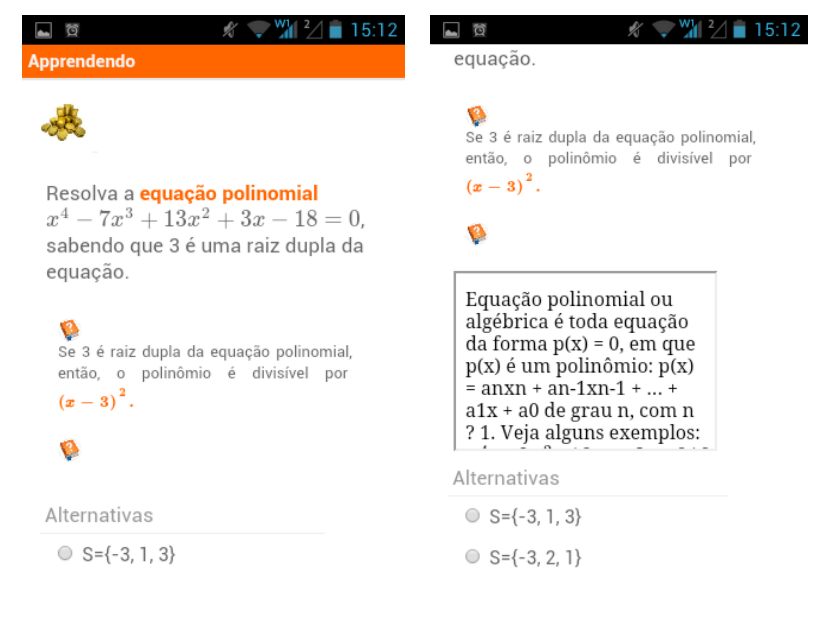
APPrendendo attacked that by a specific angle: teaching math through problem-solving, with the system mapping where each student's knowledge gaps are as they work through questions. Unlike a textbook or a platform with content laid out in sequence, APPrendendo has no fixed progression. The student opens a session, finds a multiple-choice question, and has to handle it.
Questions, hints, topics
The system never shows the answer. Instead, it offers two resources the student can pull during the attempt:
- Hints: short texts that point at the line of reasoning without handing over the math. Each hint costs points (coins).
- Topics: chunks of the formal content (formulas, definitions) that can appear inside the question text, inside a hint, or nested inside another topic. Topics are free.
The split is intentional. A hint is direct help with the question. A topic is background content the student should be able to consult freely without being penalised. The scoring rule forces the student to try first and only open a hint when they're actually stuck.
On-demand mapping
The interesting part of the design is what falls out. The sequence of hints and topics the student asks for becomes a trace of what they don't know.
Each session records three metrics: correct answers, independence (% of questions solved without any hints), and coins earned. Over many sessions, the student's profile accumulates charts of those metrics, and the teacher's admin panel cross-references them with the content tags of the questions. Low independence on polynomial equations shows the student is hitting second-grade algebra without factoring; a topic repeatedly opened on "law of cosines" shows the trigonometry prerequisite is shaky.
The system doesn't say "study this now". It surfaces the map for whoever's reading.
Theoretical grounding
The thesis anchors on Cognitive Load Theory (Sweller, 1988; 1999; Hollender et al, 2010). Central idea: the way content is presented consumes cognitive resources separate from the content itself. A cluttered interface steals bandwidth from the reasoning. For an educational tool, UX stops being decoration and becomes a variable that changes performance. APPrendendo's choices (lean interface, hint and topic as actions with different weights, no answer in the flow) come out of that frame.
The project also fits three concepts that were emerging in 2013 and are mainstream today: u-learning (ubiquitous learning, anywhere and anytime), m-learning (mobile learning), and edutainment (educational entertainment, gamification). The coins and the independence metric are the edutainment hook; the multi-platform web app is the m-learning and u-learning.
The platform pivot
The first attempt was a native Android app (Android Studio with Java). The thesis records that the move to web came from a practical observation: the database lived on the server, so internet was a requirement either way. A native app only added friction without solving the connectivity problem.
Final stack: PHP and MySQL on the server, HTML5/CSS/JS on the client, jQuery for AJAX. The thesis cites Allen et al (2012) and Brandon (2012) defending this choice for multi-platform apps of that era. The system isn't online anymore and the source wasn't versioned. What's left is the thesis PDF, with requirements, UML diagrams, data model, and screenshots.
Download the thesis · PDF · ~1 MB (Portuguese)